Problem Solving
🧩 At A1 Infinity Nexus, problem solving support helps businesses identify what is actually causing an operational issue, understand its impact, evaluate practical responses, and put structured improvements into action. We focus on evidence, root causes, clear actions, and follow-through so recurring problems can be addressed rather than repeatedly patched.
🔍 What Professional Business Problem Solving Involves
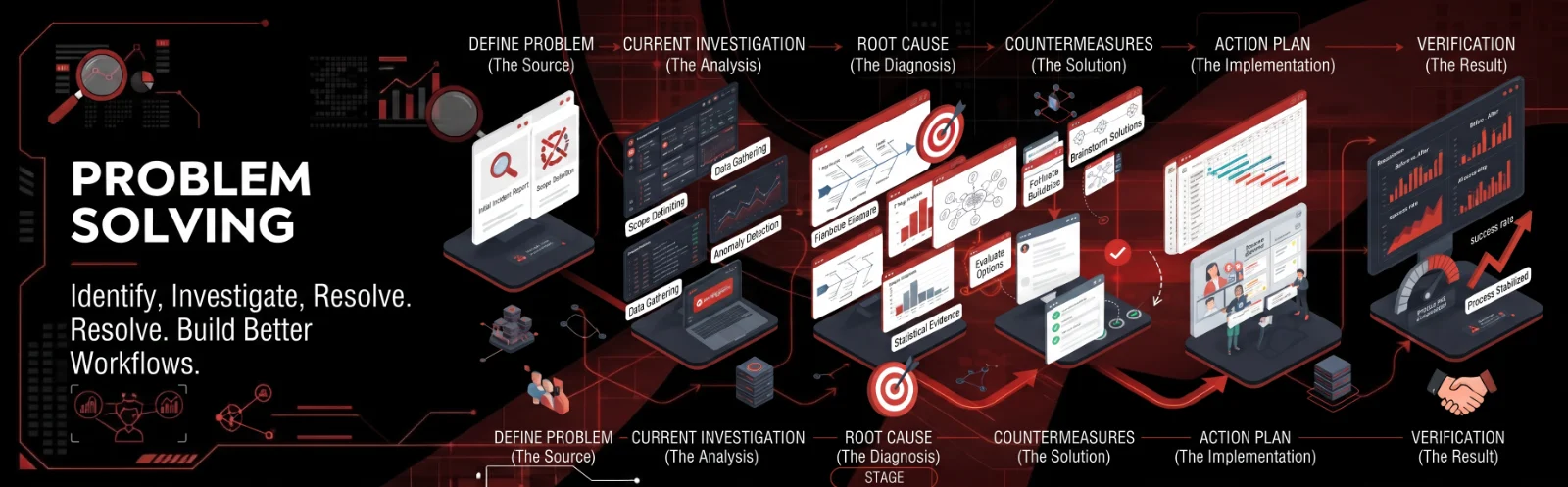
Business problems rarely exist as isolated events. A missed deadline, recurring customer complaint, inaccurate data, inefficient workflow, or repeated operational error can often be connected to a deeper process issue. Effective problem solving starts by clearly defining the gap, understanding the current situation, identifying contributing and root causes, and determining practical countermeasures that can be tested and improved.
⚠️ Problems We Can Help Investigate
| Business Problem | How We Can Help |
|---|---|
| Recurring operational errors | Examine the workflow, identify contributing factors, and help develop corrective actions. |
| Repeated customer issues | Organize complaints, identify patterns, investigate causes, and support preventive improvements. |
| Process delays | Map the current workflow, locate bottlenecks, and identify practical ways to reduce unnecessary steps. |
| Data inaccuracies | Review the information flow, identify where errors enter the process, and establish stronger controls. |
| Missed tasks or follow-ups | Examine responsibilities, handoffs, tracking methods, and workflow gaps that allow work to be missed. |
| Inconsistent results | Identify differences in how work is performed and develop clearer standards or procedures. |
| Manual or inefficient workflows | Analyze recurring work and identify opportunities for process improvement or automation. |
| Problems that keep returning | Move beyond immediate fixes by investigating underlying causes and establishing follow-up controls. |
🛠️ What We Can Handle Across Problem Solving
Problem Definition & Scope
Turn a broad business concern into a clearly defined problem by identifying what is happening, where it occurs, who or what is affected, and what outcome needs to change.Current-State Investigation
Review the existing workflow, available information, records, communication, processes, and operating conditions to establish what is actually happening instead of relying only on assumptions.Root Cause Analysis
Investigate direct, contributing, and underlying causes using structured analysis so the business can distinguish the visible symptom from the conditions that are allowing the problem to continue.Process & Workflow Analysis
Examine how work moves between people, systems, documents, tasks, and approval points to identify bottlenecks, unnecessary steps, unclear handoffs, duplication, or other sources of operational friction.Issue & Pattern Analysis
Organize recurring issues, complaints, errors, delays, or exceptions to identify patterns that may reveal where a broader business problem is developing.Countermeasure Development
Help identify practical actions that address the confirmed causes, considering the existing business process, available resources, responsibilities, and the desired future condition.Corrective Action Support
Help organize and track actions designed to address an identified problem, including responsibilities, deadlines, required changes, documentation, and follow-up checks.Problem-Solving Documentation
Structure problem statements, findings, cause analysis, action plans, checklists, procedures, and follow-up records so the reasoning and actions remain clear for the people involved.Follow-Up & Verification
Review whether implemented changes actually improved the situation and whether the original problem or gap is still occurring before considering the process complete.
🧭 How We Work Through a Business Problem
1. Clarify the Problem
We define the specific issue instead of treating a broad symptom as the entire problem. This includes understanding the expected condition, actual condition, scope, impact, and the measurable gap that needs attention.
2. Understand the Current Situation
We examine the available facts, workflow, records, communication, data, and process conditions to build a clearer picture of what is happening and where the problem appears.
3. Identify the Causes
We investigate possible contributing factors and test the logic between causes and effects. Where appropriate, root-cause techniques such as structured questioning and cause analysis can help move the investigation beyond the immediate symptom.
4. Develop Practical Countermeasures
Instead of immediately assuming there is one permanent solution, we identify practical changes that can address the confirmed causes and move the process toward the required condition.
5. Put the Changes Into Action
Actions are organized with clear responsibilities, timing, documentation, and follow-up requirements so recommendations do not remain as ideas sitting in a report.
6. Check the Result
The outcome is reviewed against the original problem and target. If the change did not produce the required result, the findings can feed into another problem-solving cycle rather than closing the issue prematurely. This reflects the iterative logic of PDCA and continuous improvement.
💎 What Better Problem Solving Can Give Your Business
Fewer recurring problems by addressing underlying causes instead of repeatedly dealing with the same symptoms.
Clearer operational decisions because actions are connected to the actual problem, available evidence, and desired outcome.
More efficient workflows by identifying unnecessary steps, bottlenecks, unclear responsibilities, and process gaps.
Better accountability through documented actions, ownership, deadlines, and follow-up requirements.
Continuous improvement by turning lessons from individual problems into stronger processes, standards, and working practices.
🏢 Problem Solving Across Different Business Functions
Problem-solving support can be applied across business operations, administration, customer support, CRM workflows, sales processes, lead generation, e-commerce, marketplace operations, real estate, property management, data management, project coordination, and internal team workflows. The specific investigation depends on the business problem, its impact, available information, and the people or systems involved.
📋 From Immediate Fixes to Preventive Improvements
A quick fix can restore normal operations, but it does not necessarily prevent the issue from returning. Our approach separates immediate corrective action from longer-term improvement where appropriate, helping identify what needs to be fixed now, what caused the problem, and what process change can reduce the chance of recurrence.
🎯 Built Around the Reality of Your Business
There is no single problem-solving method that fits every business situation. A small recurring administrative error may require a simple workflow review, while a larger operational issue may require deeper data analysis, root-cause investigation, documented countermeasures, and repeated follow-up. We adapt the level of analysis to the complexity and impact of the problem.
📊 Problem-Solving Documentation & Tracking
Clear documentation helps turn problem solving into an actionable business process. We can structure problem statements, findings, cause-and-effect information, action plans, corrective actions, checklists, SOP updates, and follow-up records so stakeholders can understand what was identified, what changed, who is responsible, and whether the change worked.
💻 Problem Solving Tools & Platforms
| Area | Tools & Platforms |
|---|---|
| Documentation | Google Docs, Microsoft Word, Notion |
| Data Analysis | Excel, Google Sheets, Airtable |
| Task & Action Tracking | Asana, Trello, ClickUp, Monday.com |
| Communication | Slack, Microsoft Teams, Google Chat |
| Project Coordination | Asana, ClickUp, Trello, Monday.com |
| CRM Investigation | HubSpot, Salesforce, Zoho CRM |
| Process Documentation | Google Workspace, Microsoft 365, Notion |
| Reporting | Excel, Google Sheets, Looker Studio, Power BI |
| Business Records | CRM systems, databases, spreadsheets, internal platforms |
🔄 Problem Solving That Leads to Better Processes
Problem solving should not end when an issue appears to be fixed. Findings from recurring problems can reveal weaknesses in workflows, documentation, training, data controls, responsibilities, or systems. Where appropriate, those findings can be converted into updated procedures, stronger controls, clearer standards, or process improvements that help the business operate more reliably.
🔗 Continue Strengthening Your Business Operations
Process Improvement - Turn identified operational problems into structured workflow improvements and more efficient ways of working.
Quality Assurance (QA) - Strengthen quality controls, review procedures, issue tracking, and continuous improvement after problems are identified.
FAQ - Learn more about how A1 Infinity Nexus works, our support approach, and common client questions.
🚀 Move From Repeated Problems to Practical Action
Recurring business problems consume time, create unnecessary work, and make it harder for teams to focus on growth. A1 Infinity Nexus provides structured problem-solving support designed to understand the issue, investigate its causes, coordinate practical actions, and help your business build better ways of working.
📩 Start Your Problem-Solving Support
Tell us what keeps going wrong, where the issue appears, or which workflow is creating repeated difficulties, and we can help structure the investigation around your business requirements.
💼 Flexible Engagements
Problem-solving support can be arranged around individual business issues, recurring operational problems, workflow investigations, corrective-action projects, or broader continuous-improvement initiatives.
What is included
- Review your current workflow, goals, tools, and recurring challenges
- Create a clear task plan with priorities, ownership, and deadlines
- Complete and document the work with careful quality checks
- Provide proactive progress updates and flag issues before they grow
- Build reusable templates, checklists, and standard operating procedures
- Track results and continuously improve the process
Tools & platforms
Google Workspace, Microsoft Office, Slack, Zoom, Notion, Trello, Asana
Expected outcome
More time, fewer missed details, clear priorities, and dependable day-to-day execution.
Who this is for
Hourly & Project-Based Services
We work on both hourly and project-based engagements.