
What Does a Virtual Assistant Do? 15+ Tasks, Duties & Business Benefits | A1 Infinity Nexus
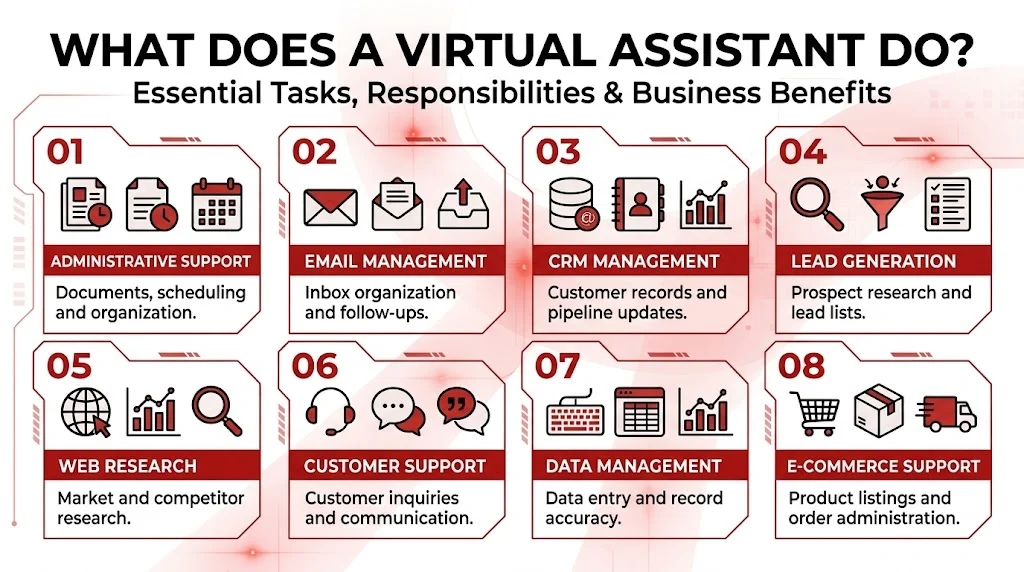
A virtual assistant is a remote professional who helps businesses complete important tasks without being physically present in an office. Depending on the agreement, their responsibilities may include administrative support, email management, CRM management, customer communication, research, data management, lead generation, e-commerce operations, and project coordination.
Today, businesses of all sizes use virtual assistance to organize daily operations, manage recurring responsibilities, improve productivity, and make better use of their time.
But what exactly does a virtual assistant do? Which tasks can businesses delegate? And how can companies build an effective working relationship with remote support professionals?
This guide explores virtual assistant responsibilities, practical business applications, delegation strategies, performance measurement, and the benefits of working with a professional remote support provider.
What Is a Virtual Assistant?
A virtual assistant (VA) is a professional who provides administrative, operational, research, customer support, or other business services remotely.
Virtual assistants typically use digital communication platforms, cloud-based tools, spreadsheets, documents, CRM systems, and project management software to complete assigned responsibilities.
Their exact duties depend on their experience, verified skills, and the requirements of the business.
Some companies need occasional assistance with research or data entry. Others require ongoing support with customer communication, administrative coordination, lead generation, listing management, and operational workflows.
A virtual assistant can work on:
One-time projects.
Hourly assignments.
Recurring weekly or monthly responsibilities.
Ongoing operational support.
Specialized administrative and business processes.
The main objective is to help businesses complete suitable work efficiently while allowing owners and teams to concentrate on important decisions and business development.
What Tasks Can a Virtual Assistant Do?
Virtual assistants can handle a wide range of responsibilities depending on their capabilities and the agreed scope of work.
Here are some of the most common virtual assistant tasks businesses can delegate.
1. Administrative Support
Administrative support helps businesses maintain organized records, documents, communication, and daily responsibilities.
Common tasks include:
Document preparation and formatting.
File and folder organization.
Email management.
Calendar and appointment coordination.
Spreadsheet management.
Data entry and record maintenance.
Routine administrative follow-ups.
Task tracking and documentation.
2. Email Management
Email management helps businesses organize incoming and outgoing communication.
Typical responsibilities include:
Organizing inboxes and email folders.
Categorizing incoming messages.
Preparing email drafts.
Managing routine correspondence.
Tracking unanswered messages.
Organizing follow-up reminders.
Maintaining communication records.
Businesses should establish clear response guidelines and approval requirements before delegating customer or business correspondence.
3. CRM Management
Customer Relationship Management (CRM) systems help businesses organize customer information, prospects, interactions, and sales activities.
A virtual assistant may support CRM operations through:
Updating contact information.
Maintaining customer records.
Organizing prospect databases.
Identifying duplicate records.
Updating lead statuses.
Tracking follow-up activities.
Maintaining data accuracy.
Preparing CRM reports.
Accurate CRM records help businesses maintain organized information and improve visibility across customer relationships.
4. Lead Generation and Prospect Research
Lead generation involves identifying potential customers or business opportunities that match specific requirements.
A virtual assistant may assist with:
Identifying relevant businesses.
Researching potential customers.
Finding decision-makers.
Collecting publicly available business contact information.
Building prospect lists.
Verifying available contact details.
Organizing lead information.
Maintaining lead-generation spreadsheets.
The business should define its target audience, industry, location, company size, decision-maker roles, and qualification requirements before research begins.
5. Web Research and Data Collection
Businesses frequently need accurate information to support planning, marketing, operations, and decision-making.
Research-related responsibilities may include:
Company and industry research.
Competitor research.
Market research.
Product and service research.
Business directory research.
Contact information research.
Information collection from public websites.
Organizing research findings into structured reports.
The quality of research depends on reliable sources, clear requirements, and appropriate verification.
6. Customer Support
Customer support assistance helps businesses organize customer inquiries and maintain consistent communication.
Depending on the agreed responsibilities, tasks may include:
Responding to routine customer inquiries.
Organizing support requests.
Recording customer issues.
Updating customer information.
Following up on unresolved requests.
Maintaining support documentation.
Escalating complex issues to the appropriate team member.
Clear communication guidelines and escalation procedures help maintain service quality.
7. Data Entry and Data Management
Data management involves organizing, updating, maintaining, and checking business information.
Common responsibilities include:
Entering information into spreadsheets.
Updating business databases.
Organizing digital records.
Cleaning existing datasets.
Identifying missing information.
Checking duplicate entries.
Maintaining structured records.
Preparing data summaries.
Businesses benefit from establishing consistent formatting rules, required fields, and validation standards.
8. E-Commerce and Marketplace Support
Online businesses often require regular assistance maintaining product information, marketplace records, and order-related administration.
A virtual assistant with relevant experience may handle:
Product listing creation.
Product information updates.
Product catalog organization.
Inventory record maintenance.
Order administration.
Customer inquiry coordination.
Spreadsheet and product data management.
Marketplace listing maintenance.
Responsibilities depend on the platform, business requirements, and the assistant's verified experience.
9. Real Estate and Property Support
Real estate professionals and property management businesses handle recurring administrative, research, communication, and listing responsibilities.
A virtual assistant with relevant property experience may assist with:
Property research.
Real estate lead generation.
Property listing administration.
Rental listing updates.
CRM and contact management.
Tenant inquiry coordination.
Property information organization.
Appointment and follow-up tracking.
Short-term rental administrative support.
Booking-related record management.
These responsibilities can help property professionals maintain organized information and manage recurring administrative workloads.
10. Project Coordination and Task Management
Project coordination helps businesses maintain visibility over assignments, deadlines, responsibilities, and progress.
Typical tasks include:
Organizing project documentation.
Maintaining task lists.
Tracking deadlines.
Updating project records.
Coordinating routine follow-ups.
Preparing progress reports.
Organizing shared resources.
Identifying pending tasks.
A virtual assistant can support coordination, while project owners retain responsibility for major decisions and approvals.
Virtual Assistant Tasks by Business Type
Virtual assistant responsibilities vary according to the business model, industry, operating structure, and workload.
Different businesses may require different combinations of administrative and operational support.
Small Businesses and Startups
Small businesses often need assistance organizing their daily responsibilities without building large administrative teams.
Suitable tasks include:
Organizing business documents and spreadsheets.
Managing routine email correspondence.
Maintaining customer records.
Researching potential customers and suppliers.
Preparing reports.
Tracking recurring business tasks.
Coordinating administrative activities.
E-Commerce Businesses
E-commerce companies frequently manage product information, customer inquiries, orders, and marketplace records.
A virtual assistant may help with:
Product listing administration.
Catalog updates.
Customer inquiry management.
Order record organization.
Product data entry.
Inventory-related documentation.
Marketplace administration.
Professional Service Businesses
Consultants, agencies, and other service providers often require support with client records and recurring administrative work.
Possible responsibilities include:
Client information management.
Appointment coordination.
Document preparation.
Proposal formatting.
CRM updates.
Project documentation.
Client follow-up tracking.
Growing Teams and Established Companies
Larger or growing teams may need additional support maintaining consistent internal workflows.
Suitable responsibilities include:
Administrative coordination.
Internal documentation.
CRM data maintenance.
Project task tracking.
Customer communication support.
Operational reporting.
Research and data organization.
The objective is not to assign every responsibility to one assistant. It is to identify suitable work that can be completed consistently within a clearly defined scope.
The Difference Between a Task and a Useful Support Function
A weak delegation request sounds like "Please help with the CRM."
A stronger request identifies the expected outcome:
"Review new contacts each afternoon, complete the required fields, flag duplicates, and send a short exception report."
The second instruction makes the work measurable and establishes clear expectations.
This distinction matters because a virtual assistant becomes more valuable when individual tasks connect to a business process.
For example:
Inbox management supports communication flow.
CRM maintenance supports reliable follow-ups.
Research supports informed decisions.
Listing management supports accurate public information.
Reporting supports business visibility.
Administrative coordination supports organized operations.
The task is the visible action. The support function is the business purpose behind it.
How to Decide What to Delegate First
Businesses should begin by identifying recurring responsibilities that consume time and can be completed using clear instructions and established procedures.
The following steps can help establish a practical delegation process.
1. List Recurring Responsibilities
Identify tasks that appear regularly, including administrative work, research, data entry, communication, reporting, and coordination.
2. Separate Decisions from Preparation
Keep decisions that require business authority, professional judgment, or specialist expertise.
Delegate suitable preparation, organization, research, documentation, and follow-through.
3. Choose a Small Starting Scope
Start with a manageable assignment rather than transferring numerous responsibilities immediately.
A smaller project makes it easier to evaluate instructions, accuracy, communication, and turnaround time.
4. Document the Expected Result
Define the required input, instructions, finished format, deadline, quality standards, and approval requirements.
5. Review and Improve the Process
Evaluate the completed work, identify unclear instructions, improve templates, and determine whether the assignment should become recurring support.

How to Create a Virtual Assistant Task Delegation Plan
A delegation plan helps businesses move from informal task assignments to a more organized working arrangement.
Before beginning an engagement, identify the work, define the expected outcomes, and establish how completion will be reviewed.
A practical delegation plan should cover the following areas:
| Planning Area | What to Define |
|---|---|
| Task description | What work needs to be completed? |
| Business objective | Why is the task important? |
| Required information | Which files, records, or instructions are needed? |
| Tools and access | Which approved platforms should be used? |
| Responsibility | Who completes, reviews, and approves the work? |
| Deadline | When should the task be completed? |
| Quality standards | What makes the finished work acceptable? |
| Reporting | How should progress be communicated? |
Example: CRM Data Organization
Imagine a business wants to improve the accuracy of its customer records.
Instead of providing a general instruction to organize the CRM, it creates a defined assignment:
Objective: Improve the completeness and consistency of customer records.
Input: Existing CRM contact records.
Required work: Review required fields, identify incomplete records, flag possible duplicates, and organize exceptions.
Quality standard: Follow agreed data-entry and validation rules.
Final output: Updated records and a summary of issues requiring business-owner review.
This approach makes expectations clearer and provides a practical way to evaluate completed work.
A delegation plan should remain flexible. As the assistant becomes familiar with the workflow, instructions, templates, and reporting requirements can be refined to reduce unnecessary back-and-forth communication.
How to Work Effectively with a Virtual Assistant
Remote support works best when both sides agree on how work will enter the system and how progress will be communicated.
Clear expectations, realistic deadlines, useful collaboration tools, onboarding resources, feedback, and documented workflows help establish an effective working relationship.
1. Use One Clear Starting Brief
A good brief should identify:
The objective.
Relevant business background.
Exact output required.
Deadline.
Relevant files and tools.
Examples and instructions.
A text-first approach also creates a record that can be reviewed later.
This supports A1 Infinity Nexus's working philosophy of less unnecessary communication and more execution. One clear message can often be enough to begin organizing the work, while a meeting or call can still be arranged when a project genuinely requires one.
2. Agree on Ownership and Escalation
Define what the assistant can complete independently, what requires approval, and what must be escalated.
For example, an assistant may organize prospect information, update CRM records, or prepare a report, while the business owner decides which prospects to contact or what commercial action to take.
3. Protect Access to Business Information
Remote support may involve customer records, business documents, CRM systems, and shared drives.
Good security practices include:
Strong passwords.
Multi-factor authentication.
Individual user accounts.
Appropriate access permissions.
Secure file-sharing methods.
Regular access reviews.
Written confidentiality expectations.
Businesses should provide only the access required for the agreed responsibilities.
4. Create a Simple Review Rhythm
Progress does not require constant meetings.
A written update can explain:
What has been completed.
What is waiting for information.
What requires attention.
What comes next.
For recurring responsibilities, agree on a reporting schedule and a small number of meaningful performance checks.
Common Virtual Assistant Management Mistakes to Avoid
Hiring remote support does not automatically improve business productivity. Results depend on how responsibilities are assigned, instructions are communicated, and completed work is reviewed.
Businesses should avoid these common mistakes.
1. Assigning Unclear Responsibilities
Instructions such as "manage everything" or "handle the administration" leave too much room for misunderstanding.
Define specific responsibilities, expected outputs, priorities, and approval requirements.
2. Delegating Without Providing Context
An assistant may understand how to complete a task but not why it matters.
Providing relevant business context helps them understand priorities, recognize unusual situations, and follow the correct process.
3. Expecting Immediate Results Without Onboarding
Even experienced assistants need time to understand a company's systems, terminology, communication standards, and internal procedures.
A structured onboarding process helps establish consistency.
4. Providing Excessive System Access
Remote support should operate with appropriate permissions.
Avoid sharing unnecessary credentials or unrestricted access to confidential information. Use individual accounts and role-based permissions wherever possible.
5. Measuring Activity Instead of Outcomes
Counting completed tasks does not always demonstrate business value.
Review accuracy, timeliness, completeness, consistency, and the usefulness of completed work.
6. Changing Priorities Without Updating Instructions
When business requirements change, communicate the new priority, revised deadline, and affected responsibilities.
This helps prevent duplicated effort and conflicting instructions.
Avoiding these mistakes creates a more predictable working relationship and helps businesses receive meaningful support rather than simply outsourcing disconnected tasks.
How to Measure the Performance of a Virtual Assistant
A virtual assistant's performance should be evaluated against the responsibilities and outcomes agreed upon at the beginning of the engagement.
Different assignments require different performance measures.
| Support Area | Useful Performance Indicators |
|---|---|
| Administrative support | Task completion, accuracy, and deadline adherence |
| Email management | Inbox organization and follow-up completion |
| CRM management | Record completeness and data accuracy |
| Research | Source reliability and relevance |
| Customer support | Response quality and follow-up consistency |
| Project coordination | Task visibility and milestone tracking |
| E-commerce support | Listing accuracy and record completeness |
Establish a Baseline Before Evaluating Improvements
For recurring responsibilities, first understand the existing process.
Record current turnaround times, common errors, outstanding tasks, or documentation gaps.
Then compare future results against that baseline.
For example, a business that regularly finds incomplete CRM records can monitor the percentage of records meeting its required data standards.
This provides a more meaningful performance indicator than simply counting how many records were reviewed.
Performance reviews should also consider changing workloads, task complexity, available information, and dependencies outside the assistant's control.
The purpose of measurement is to improve the working process, identify support needs, and maintain clear expectations.
How to Choose the Right Virtual Assistant
The right choice depends on the work, not just on a general label such as virtual assistant.
Look for a match between the required workflow and the person's verified skills, tools, communication style, and availability.
Consider the following questions before selecting a support provider.
Does the Person Have Experience with the Actual Work?
Administrative coordination, CRM management, research, customer support, data work, listings, and e-commerce operations require different skills and quality checks.
Look for relevant experience rather than relying on a general service description.
Can They Explain How They Protect Accuracy?
Ask how they handle duplicate records, missing information, unclear instructions, revisions, and final quality checks.
Can They Work with Your Existing Tools?
A practical support partner should be able to fit the agreed workflow rather than force the business into an unnecessary system change.
Is the Communication Style Compatible?
Some teams need frequent updates, while others prefer concise written progress reports.
Agree on communication expectations before work begins.
Can the Scope Remain Clear?
A capable provider should explain what is included, what requires approval, and what would need a different specialist.
Virtual Assistant vs. In-House Administrative Employee
Businesses sometimes compare hiring a virtual assistant with employing an in-house administrative employee.
Both arrangements can provide valuable support, but they differ in working structure, availability, responsibilities, and management requirements.
| Comparison Area | Virtual Assistant | In-House Employee |
|---|---|---|
| Working arrangement | Usually remote | Usually office-based or company-defined hybrid |
| Location | Can work from another location | Often works at the company's location |
| Engagement | May be project-based, hourly, or recurring | Commonly an employment arrangement |
| Communication | Primarily through digital channels | Digital and direct workplace communication |
| Equipment and tools | Depends on the agreement | Depends on company arrangements |
| Daily coordination | Requires clear remote workflows | Can involve direct workplace coordination |
| Task scope | Defined by the service agreement | Defined by the employment role |
Neither arrangement is automatically better.
The right choice depends on workload, operating model, required supervision, budget, confidentiality requirements, and the nature of the responsibilities.
A virtual assistant may be suitable when a business needs flexible remote support for defined administrative or operational responsibilities.
An in-house employee may be more appropriate when a role requires continuous physical presence, direct supervision, or responsibilities deeply integrated into daily office operations.
Businesses should compare actual requirements rather than choosing solely on the basis of cost or job title.
Benefits of Hiring a Virtual Assistant
Working with a virtual assistant can provide several operational advantages when responsibilities are properly defined and managed.
1. More Time for Important Business Activities
Delegating suitable recurring work allows business owners and teams to concentrate on planning, customers, business development, and important decisions.
2. Organized Daily Operations
Consistent administrative support can help maintain documents, records, communication, and recurring workflows.
3. Flexible Support Arrangements
Businesses can define support around specific projects, recurring responsibilities, or changing operational requirements.
4. Improved Information Management
Properly managed CRM records, spreadsheets, customer information, and documentation can improve internal visibility.
5. Better Task Visibility
Defined responsibilities and regular written updates make it easier to understand progress and identify pending work.
6. Support for Business Growth
As workloads increase, businesses may need additional administrative and operational capacity. Remote assistance can provide support for suitable responsibilities without requiring every task to be handled by existing team members.
The actual benefits depend on the quality of the workflow, the assistant's capabilities, and the business's management practices.
How A1 Infinity Nexus Approaches Virtual Assistance
A1 Infinity Nexus positions virtual assistance as part of broader remote business support rather than as a narrow list of isolated tasks.
Its service areas include:
Virtual assistance.
Executive and administrative support.
CRM management.
Customer support.
Lead generation.
Web and business research.
Data management.
E-commerce and marketplace support.
Real estate and property support.
Listing administration.
Operations and reporting.
Document management.
Workflow coordination.
The company's approach is built around understanding the client's goals, tools, priorities, and preferred way of working; organizing workflows with clear ownership and reporting; and delivering carefully with proactive communication and continuous improvement.
That model is designed to adapt across industries, markets, business sizes, and operating environments according to actual requirements.
Businesses can explore the remote business support services offered by A1 Infinity Nexus to understand how different administrative and operational responsibilities can be supported.
What a Virtual Assistant Should Not Replace
Delegation is not a substitute for ownership, professional judgment, or legal and regulatory responsibility.
A business should retain decisions that require its authority and use appropriately qualified professionals for regulated work such as:
Legal advice.
Tax advice.
Accounting judgments.
Medical decisions.
Other specialist services outside the agreed capability.
A virtual assistant can often support the preparation, organization, documentation, research, or administration around such work, but the boundaries must remain clear.
Frequently Asked Questions
What Does a Virtual Assistant Do on a Daily Basis?
A virtual assistant's daily responsibilities depend on the client's requirements.
Common activities include managing emails, updating CRM records, conducting research, organizing documents, entering data, coordinating customer communication, maintaining listings, and tracking assigned tasks.
Can a Virtual Assistant Support More Than Administrative Tasks?
Yes. Depending on verified capabilities and the agreed scope, virtual assistance may include CRM updates, customer-support administration, research, lead-list development, data management, listing support, e-commerce operations, reporting, and project coordination.
Is a Virtual Assistant Suitable for an Established Company as Well as a Startup?
Yes. Startups may use support to organize early operations, while established teams may need assistance with recurring workflows, data maintenance, research, customer communication, or project coordination.
The engagement should be designed around the actual business process.
Can a Virtual Assistant Work Remotely?
Yes. Virtual assistants generally complete their responsibilities remotely using approved digital tools, communication platforms, cloud-based systems, and shared documents.
What Skills Should a Virtual Assistant Have?
Useful skills depend on the assignment but may include written communication, organization, attention to detail, research, data management, CRM knowledge, document preparation, problem-solving, and familiarity with relevant business software.
Do I Need a Long Meeting Before Starting?
Not always. A clear written brief can often establish the first requirements, particularly for a defined task.
If the work involves multiple stakeholders, sensitive access, or complex decisions, a call or meeting may be useful.
How Do I Start Working with a Virtual Assistant?
Start by identifying the task, desired outcome, deadline, tools involved, and any examples or restrictions.
Then share the requirements with a support provider whose services and verified capabilities match the work.
Conclusion
A virtual assistant can do far more than complete isolated administrative tasks.
The right support partner can help businesses organize information, maintain workflows, coordinate communication, support customers, research opportunities, manage data, and keep recurring work moving.
The strongest results come from a clear scope, documented expectations, sensible access controls, and a review process that improves over time.
A1 Infinity Nexus is built around that practical idea: understand the requirement, find the workable path, execute the work, and deliver the result.
Its long-term vision is to remain adaptable as technology, platforms, markets, and business models evolve, providing Business Solutions Without Limits without limiting the company to one industry, one country, or one generation of business.
Start a Conversation
If your business has important operational, administrative, research, data, customer-support, CRM, e-commerce, or real estate work that needs organized follow-through, A1 Infinity Nexus welcomes the opportunity to understand your requirements.
Explore the A1 Infinity Nexus services and discover how organized remote support can help your business manage recurring responsibilities.
Ready to discuss your requirements? Contact A1 Infinity Nexus and share the objective, current process, tools, deadline, and expected output to help establish a clear starting point.